
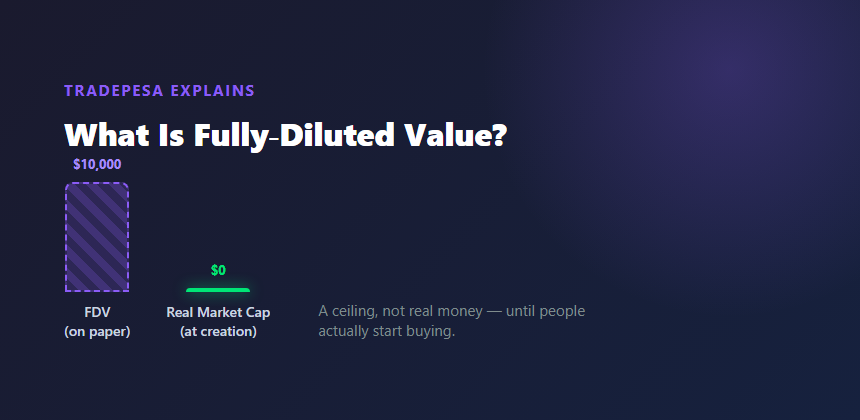
Create a token on TradePesa and you'll see a number next to it called "fully-diluted value," or FDV. It sounds technical, but the idea behind it is simple — and understanding it will save you from a very common misread of what a new token is actually worth.
What FDV actually means
Fully-diluted value is a hypothetical: if every token that could ever exist for a given coin were already in circulation and trading at the current price, what would the whole thing be worth? You get it by multiplying price by max supply. Nothing more.
The word "diluted" is doing the work here. Most tokens don't start with their full supply already in traders' hands — more gets released over time. FDV answers "what if it were all out there already," which is why it's sometimes bigger, even much bigger, than what a token is really worth today.
Why TradePesa shows you this number
Every token on TradePesa launches with zero tokens in circulation. Not the creator, not anyone — nobody pre-owns any supply. What a token's starting price and max supply actually do is shape a bonding curve: the formula that decides how the price moves as people buy in. Real market cap is always price × circulating supply, and circulating supply starts at exactly 0. So a brand-new token's real market cap is $0, full stop, no matter what price or supply its creator picked.
FDV, on the other hand, can be enormous on day one, because it's just price × max supply — a number that exists purely on paper, before a single person has bought in. That gap between "$0 real" and "huge on paper" is exactly what FDV is there to make visible.
The $10,000 ceiling on new tokens
Because FDV costs nothing to inflate — a creator could type in a high price and a huge max supply and claim a token is "worth" a fortune with zero money behind it — TradePesa caps it at token creation. Starting price × max supply can't imply more than a $10,000 fully-diluted value. The create-token form calculates this live as you type, in both USD and KES, so you can see exactly where you stand before you submit.
This isn't a cap on how valuable a token can eventually become — real trading, real demand, and real circulating supply can take a token's real market cap well past that. It's only a cap on the unearned, on-paper number a creator can claim before anyone has bought anything.
- Real market cap = price × circulating supply (starts at $0 for every new token)
- Fully-diluted value = price × max supply (a ceiling, capped at $10,000 equivalent at creation)
- The gap between the two closes only as real people make real purchases
What this means if you're creating a token
Don't chase a big FDV number for its own sake — it isn't money, and it isn't a signal of anything except the math you typed into two fields. What actually matters is a starting price and supply that make sense for how you want your token to trade: a very high starting price with a small supply behaves differently from a very low price with a large one, even at the same FDV. Set numbers that fit the token you're building, not numbers that just look impressive on a card.
And if you're browsing tokens rather than creating one: when you see a market cap or FDV figure on a token card, remember which one you're looking at. Market cap reflects real trading that has actually happened. FDV is a ceiling on what's mathematically possible — useful context, but never a substitute for real volume and real holders.
Trading carries risk, and nothing here is financial advice. Only ever trade what you can afford to lose.